
Rants About New (and old) Things
Tuesday, October 13, 2009
Monday, October 12, 2009
Really Big Hat
The September club yarn from Three Irish girls was Springvale Bulky (soon to be available in non-club colorways). Since I love bulky yarn and found Springvale super soft and yummy, I couldn't see how this couldn't work out great. I decided to make the Ysolda Teague's Icing Swirl Hat. The yarn is a little bigger than the pattern calls for, but since it's supposed to be a slouchy hat anyway I just went with it. (I did throw in an extra decrease or two at the end, but that's really about it.
It's quite huge if you try to pick it up.
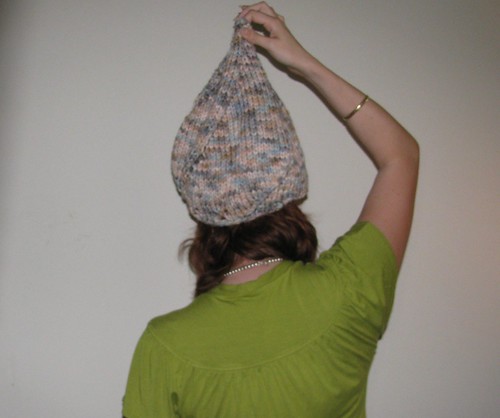
But, it looks fine if you just let it slouch.
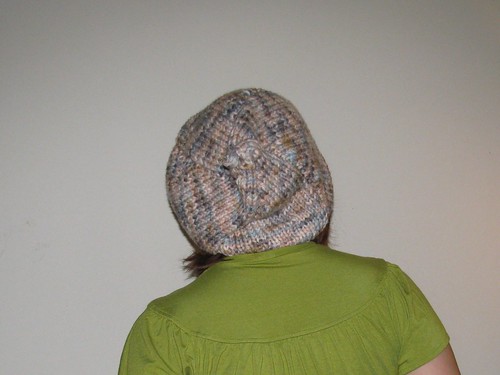
It's quite huge if you try to pick it up.
But, it looks fine if you just let it slouch.


Tuesday, October 06, 2009
A Cowl Thingy
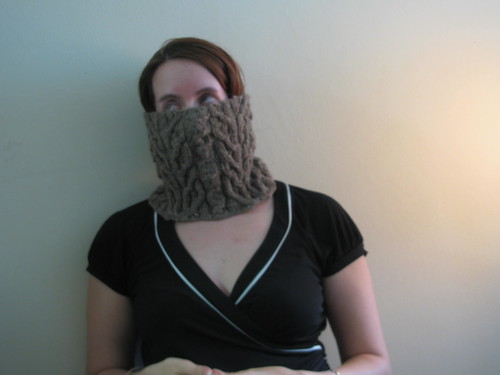
I worked much of this cowl while at the all congregation retreat on the shore. Folks would ask what I was knitting and I would answer, "A cowl" which mostly resulted in puzzled looks. This led to myself (and others, mostly knitters) to try and explain what a cowl was. We came up with:
A turtleneck with no body
A scarf that's attached to itself
A hood with no top.
None of us came up with neckwarmer.
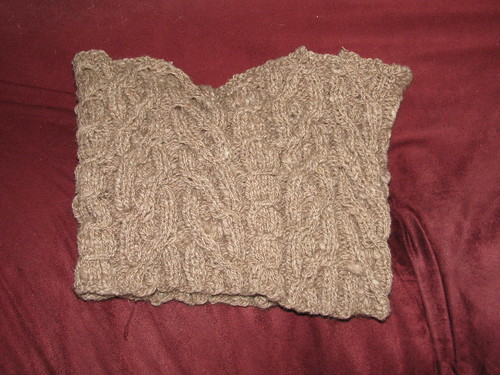
Oh well. Here it is. This amazing yarn that I got in the yarn ball swap is soft and lanolin-y. I wanted cables to show of the nubby texture and subtle color.
A turtleneck with no body
A scarf that's attached to itself
A hood with no top.
None of us came up with neckwarmer.
Oh well. Here it is. This amazing yarn that I got in the yarn ball swap is soft and lanolin-y. I wanted cables to show of the nubby texture and subtle color.
Monday, October 05, 2009
7 Things: Banned Books Oops!
Yeah, so I totally missed banned books week. But really, the idea's a good one regardless of when you celebrate (um, yeah, that's my story here, I'm trying to lengthen the celebration), so here we go.
1. The number of books challenged or banned in US libraries each year is 500, which I think is plenty since most of these books are pretty innocuous (yes, in my opinion, but we'll get to that) and since many librarians are asked not to reports any challenges received, so as with many things, this is simply the reported number.
2.And Tango Makes Three remains the most challenged. It is a true story about penguins, but since the adult penguins are both male, some people seem to think it is pro-homosexual. In my opinion, it is pro-family since the penguins are raising a child together, and it is not clear if the penguins ever had sexual feelings toward one another. I also feel fairly certain that the book, which I have not read, offers no detail about the penguins' sex lives. But anyhoo.
3. The thing about these challenges and bans is that I understand any parent's choice to have their child not read a book. But these bans or challenges are saying that no child that walks into that library or school should have access to this book and that bothers me.
4. Phillip Pullman's His Dark Materials trilogy as a group ranks number two this year. Mr. Pullman is suitably pleased. I have only read the first and while I understand that the church hierarchy that is depicted is, well, not very nice, I think that it could lead to some fascinating discussions. (I actually think that about all these books.) I also think that it is interesting that, as far as I am aware, no one ever tries to ban books about evil governments arguing that people might not understand that it is fiction.
5. Lest you think that all of these challenges occur at the elementary level, in one school a challenge was brought concerning eleventh graders who were assigned The Adventures of Huckleberry Finn. The reason given was the racist language used in the book. I read Huck Finn as a fourth grader on my own, and again as a tenth grader and had no problem understanding the context of the language. We discussed it further as a class, including the idea that the story contains an arc as Huck gets to know Jim as a person. (The school did reinstate the book for the eleventh graders.)
6. Religion and sex remain the most common reasons that challenges are brought. I can't decide if that reflects our culture in some way, or if book challenges are one of the things where parents still feel they have some power. In the end I read books about sex and didn't go out and have some just because I had read about it. Again, I am biased as a trained sex educator, but I think parents often don't with to talk to their kids about sex and also hope they never hear about it anywhere else, which simply isn't realistic.
7. Pat Conroy's Beach Music and Prince of Tides were both challenged as books used in an eleventh grade class due to graphic content. I have read both and, first, I am so jealous, I would have enjoyed reading those so much more than Wuthering Heights. Second, yes, sexual and even disturbing things happen in these books. They are messy, they are about flawed people and really, I think they are less disturbing than say, well, Wuthering Heights.
Plus, Romeo and Juliet is about two teenagers who have a secret relationship they keep from their parents. Of course, they die in the end.
1. The number of books challenged or banned in US libraries each year is 500, which I think is plenty since most of these books are pretty innocuous (yes, in my opinion, but we'll get to that) and since many librarians are asked not to reports any challenges received, so as with many things, this is simply the reported number.
2.And Tango Makes Three remains the most challenged. It is a true story about penguins, but since the adult penguins are both male, some people seem to think it is pro-homosexual. In my opinion, it is pro-family since the penguins are raising a child together, and it is not clear if the penguins ever had sexual feelings toward one another. I also feel fairly certain that the book, which I have not read, offers no detail about the penguins' sex lives. But anyhoo.
3. The thing about these challenges and bans is that I understand any parent's choice to have their child not read a book. But these bans or challenges are saying that no child that walks into that library or school should have access to this book and that bothers me.
4. Phillip Pullman's His Dark Materials trilogy as a group ranks number two this year. Mr. Pullman is suitably pleased. I have only read the first and while I understand that the church hierarchy that is depicted is, well, not very nice, I think that it could lead to some fascinating discussions. (I actually think that about all these books.) I also think that it is interesting that, as far as I am aware, no one ever tries to ban books about evil governments arguing that people might not understand that it is fiction.
5. Lest you think that all of these challenges occur at the elementary level, in one school a challenge was brought concerning eleventh graders who were assigned The Adventures of Huckleberry Finn. The reason given was the racist language used in the book. I read Huck Finn as a fourth grader on my own, and again as a tenth grader and had no problem understanding the context of the language. We discussed it further as a class, including the idea that the story contains an arc as Huck gets to know Jim as a person. (The school did reinstate the book for the eleventh graders.)
6. Religion and sex remain the most common reasons that challenges are brought. I can't decide if that reflects our culture in some way, or if book challenges are one of the things where parents still feel they have some power. In the end I read books about sex and didn't go out and have some just because I had read about it. Again, I am biased as a trained sex educator, but I think parents often don't with to talk to their kids about sex and also hope they never hear about it anywhere else, which simply isn't realistic.
7. Pat Conroy's Beach Music and Prince of Tides were both challenged as books used in an eleventh grade class due to graphic content. I have read both and, first, I am so jealous, I would have enjoyed reading those so much more than Wuthering Heights. Second, yes, sexual and even disturbing things happen in these books. They are messy, they are about flawed people and really, I think they are less disturbing than say, well, Wuthering Heights.
Plus, Romeo and Juliet is about two teenagers who have a secret relationship they keep from their parents. Of course, they die in the end.
Thursday, October 01, 2009
Thoughts on Series
In reading Evil at Heart I started to wonder what are the things that make a series with a multi-arc book work, and where is the point where the reader gives in.
I may be spoiled by romantic suspense where if the killer isn't caught at least something clear is resolved, and I felt Evil at Heart answered some questions, but I did ponder how many books I would be willing to wait to see something of this nature resolved. (I have, in contrast, been burned by series where one thematic element appeared to be dragged ever further, and there were whole books where nothing much happened. That is clearly not the case here. But I pondered.)
In contrast, I have enjoyed Rachel Vincent's were-cat series (note, in contrast because I have not sat to ponder how long I would wait for stuff to get wrapped up, the enjoyment part is not the contrast for me). Some readers have suggested that some of the books end on cliffhanger's as the bits are thrown out for the next book. So far (Vincent has suggested that there is one that ends on a cliffhanger coming) these have not bothered me. It helps that I follow Vincent's blog and knew it was part of a series, and know about how many books are left.
It can be comparable to television also, where the over arching mystery can drag on, but individual episodes may focus on smaller issues in order to provide some temporary distraction. Now, I am not picking on Chelsea Cain. I have certainly read books that did things that to me were egregious such as ending on a question. (I have seen that twice and in both cases I refused to read anything else by that person.)
Cain has said that to her, the book's focus is the relationship that develops between Archie (the leader, at least initially, of the task force, who later becomes a victim himself, although an alive one) and Gretchen (the killer). In that sense it is a bit different from a traditional serial killer novel in that, now at least, the killer is known not just to the audience but to the characters. This allows Cain to focus on things like the relationship between the cop and criminal, look at media portrayal and many other things, not the least of which is the idea that Gretchen has been dubbed the beauty killer becaase she is pretty.
So, in that sense the book provides exactly what it sets out to provide.
I may be spoiled by romantic suspense where if the killer isn't caught at least something clear is resolved, and I felt Evil at Heart answered some questions, but I did ponder how many books I would be willing to wait to see something of this nature resolved. (I have, in contrast, been burned by series where one thematic element appeared to be dragged ever further, and there were whole books where nothing much happened. That is clearly not the case here. But I pondered.)
In contrast, I have enjoyed Rachel Vincent's were-cat series (note, in contrast because I have not sat to ponder how long I would wait for stuff to get wrapped up, the enjoyment part is not the contrast for me). Some readers have suggested that some of the books end on cliffhanger's as the bits are thrown out for the next book. So far (Vincent has suggested that there is one that ends on a cliffhanger coming) these have not bothered me. It helps that I follow Vincent's blog and knew it was part of a series, and know about how many books are left.
It can be comparable to television also, where the over arching mystery can drag on, but individual episodes may focus on smaller issues in order to provide some temporary distraction. Now, I am not picking on Chelsea Cain. I have certainly read books that did things that to me were egregious such as ending on a question. (I have seen that twice and in both cases I refused to read anything else by that person.)
Cain has said that to her, the book's focus is the relationship that develops between Archie (the leader, at least initially, of the task force, who later becomes a victim himself, although an alive one) and Gretchen (the killer). In that sense it is a bit different from a traditional serial killer novel in that, now at least, the killer is known not just to the audience but to the characters. This allows Cain to focus on things like the relationship between the cop and criminal, look at media portrayal and many other things, not the least of which is the idea that Gretchen has been dubbed the beauty killer becaase she is pretty.
So, in that sense the book provides exactly what it sets out to provide.
Subscribe to:
Posts (Atom)